Vulnerability and Site Assessment
A vulnerability assessment looks at what could go wrong and where you are exposed.
It evaluates:
- Hazard and threat identification (natural hazards, technological hazards, and adversarial hazards)
- Existing security measures (policies, procedures, technology)
- Gaps or weaknesses that could be exploited
Examples:
- Are access controls sufficient?
- Are emergency plans up to date and actionable?
- Are staff trained to respond to incidents?
- Are there weaknesses in communication systems?
A site assessment focuses on the physical environment and how a specific location performs under risk conditions.
It evaluates:
- Building layout and design
- Entry/exit points and access control
- Surveillance systems (cameras, lighting)
- Perimeter security
- Emergency equipment and evacuation routes
Examples:
- Can unauthorized individuals easily access the facility?
- Are there blind spots in camera coverage?
- Are evacuation routes clearly marked and functional?
- Is the site defensible during an emergency?

Emergency Operations Planning and Strategic Planning
Emergency operations planning is the process of developing structured, actionable plans that guide how an organization prepares for, responds to, and recovers from emergencies.
It focuses on:
- Roles and responsibilities during incidents
- Communication and coordination procedures
- Incident command structure (e.g., ICS/NIMS alignment)
- Evacuation, lockdown, shelter-in-place, and reunification procedures
- Resource management and continuity of operations
In practice:
An Emergency Operations Plan (EOP) ensures that when a crisis occurs, whether it’s a natural disaster, security threat, or operational disruption, everyone knows what to do, who is in charge, and how to act quickly and effectively.
Strategic planning is a long-term, high-level process that helps organizations define goals, prioritize risks, and build capabilities to improve resilience and performance over time.
It focuses on:
- Identifying risks and organizational priorities
- Setting preparedness and security goals
- Allocating resources effectively
- Developing policies, programs, and capabilities
- Aligning leadership vision with operational readiness
In practice:
Strategic planning helps organizations move from reactive to proactive by ensuring they are intentionally building stronger systems, policies, and capabilities before a crisis occurs.
Crisis Management Training and Support
Crisis management training prepares personnel to respond confidently and effectively in real-world situations.
It includes:
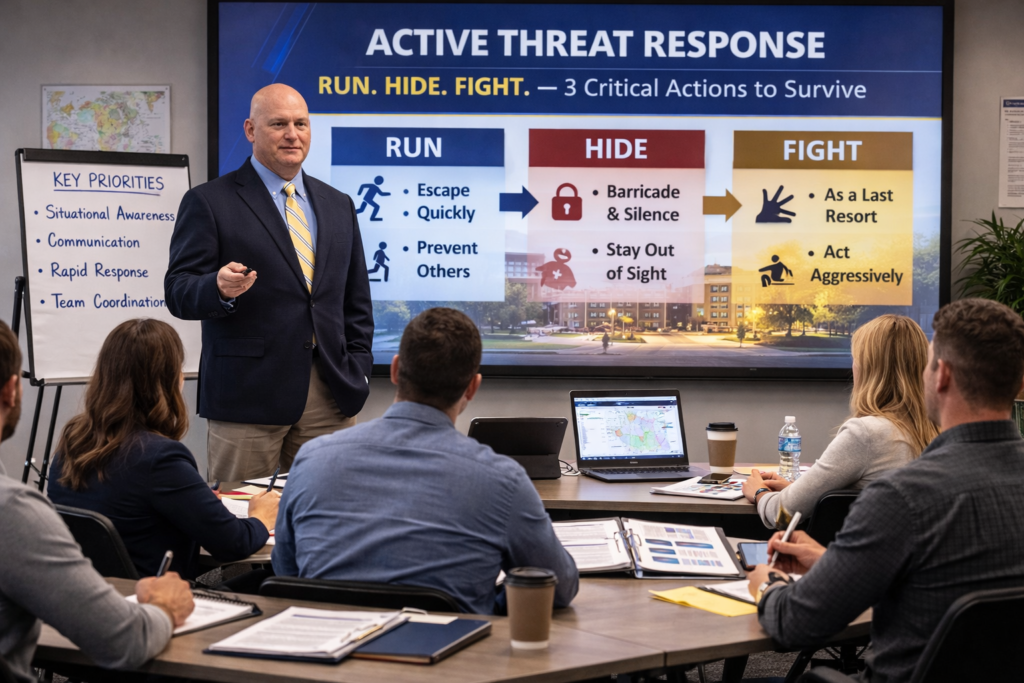
- Active threat and emergency response training
- Tabletop and full-scale exercises
- Incident Command System (ICS) and NIMS-based training
- Staff roles and responsibilities during emergencies
- Scenario-based drills tailored to the organization
In practice:
Participants practice real scenarios so they can respond quickly, communicate effectively, and execute plans under stress.
Crisis management support involves direct expert assistance before, during, and after an incident.
It includes:
- Incident response guidance and coordination
- Emergency operations center (EOC) support
- Crisis decision-making assistance for leadership
- Communication strategy and stakeholder coordination
- After-action reviews and improvement planning
In practice:
Strategic Crisis Management Consultants works alongside leadership and response teams to ensure decisions are informed, coordinated, and aligned with best practices during high-pressure situations